Christchurch Casino
Christchurch
- Address
- 30 Victoria Street, Christchurch 8013
- Published hours
- Mon–Thu & Sun 12pm–1am; Fri–Sat 12pm–3am
- Onward leg
- Queenstown · Approx. 6 hr 15 min
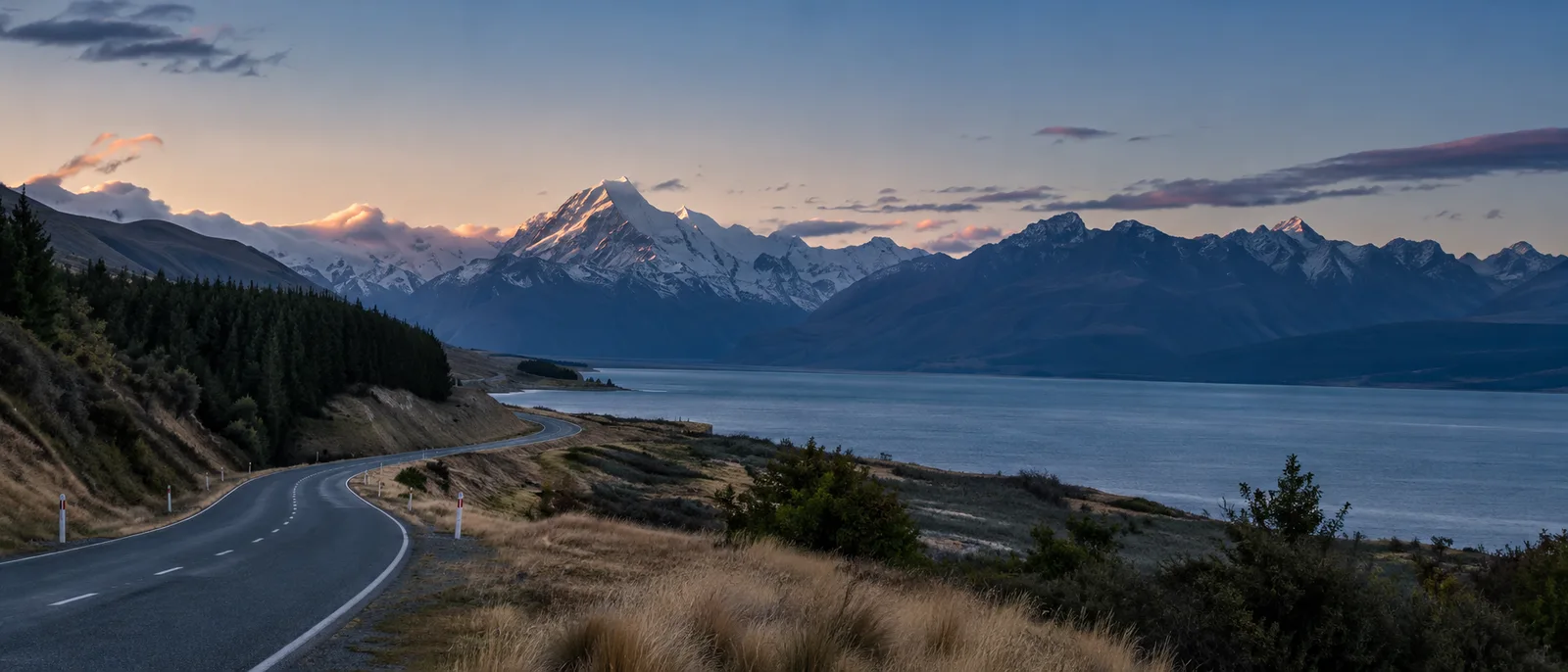
Christchurch. Queenstown. Dunedin. Three active casino stops inside a much bigger South Island story.
Explore the seven-night circuit ↗Select a marker to compare arrival facts. This is a route guide, so every casino is framed by its city and onward journey.
Christchurch
The loop is paced for daylight driving and unhurried city stays. Add weather margin in winter and use live navigation for every leg.
Open the full road tripThe full planner compares one, two or three active venues, including airports, coach context, accessibility and late-arrival caveats.
1–3 stops
Licensed photographs ground each stop in the real landscape. Full ownership, licence and crop rules are recorded in the media manifest.


Under New Zealand law, people under 20 cannot enter or remain in a casino gambling area. Carry current photo ID and check the venue’s accepted documents.
Read the practical guideHours, dress requirements and holiday arrangements belong to operators and can change.
We verify practical facts. Sponsored online offers do not rate gambling experiences, change venue order or sell casino bookings.
There are three active land-based casino venues in the operating area of this guide: Christchurch Casino in Christchurch, SkyCity Queenstown in Queenstown and Grand Casino Dunedin in Dunedin. That answer is deliberately simple. A search result can become confusing when a directory mixes casinos with racecourses, pubs that have gaming machines, historic licences or the former SkyCity Queenstown Wharf. Our maintained active set contains only the three venues that can be treated as current South Island casino destinations. The map, comparison, trip planner and route articles all inherit that same active-only dataset.
Use the homepage when the question is regional: which cities have casinos, how the three stops relate geographically, whether a multi-city route is realistic and what to verify before leaving. Use a city guide when you need orientation around an airport, central district, accommodation area or onward journey. Use a venue guide when you need the address, phone, operator, current published hours, dress information, game categories, parking context or accessibility status for one named casino. That division is intentional. It gives every page one job and prevents slightly different answers from competing with one another.
The guide is not a casino operator, regulator or booking service. Sponsored online-casino offers can appear in labelled advertising blocks, but they do not rank the quality of gambling, claim that a visit is urgent or imply that spending more produces a better trip. Its useful action is practical: compare the travel task, check the source date, build a route and open the official source when a fact can change. If gambling is not part of your plans, the route information can still explain how the three cities connect, but the venue-specific material should be read as factual orientation rather than a recommendation.
A sensible first pass takes less than a minute. Confirm that the city is one of the three active locations. Open the comparison if more than one city fits the trip. Check the appropriate route page or use the planner. Then read the venue page shortly before travel, paying attention to the checked date beside volatile fields. Hours, parking, restaurant service, poker schedules and temporary access arrangements can change more quickly than an address or operator name. A static guide should reveal that uncertainty rather than conceal it.
Christchurch Casino is the active casino entity for Ōtautahi Christchurch and Canterbury. Its maintained record is NZ-CHC-001. The verified address in the registry is 30 Victoria Street, Christchurch 8013, and the published general-enquiries phone is +64 3 365 9999. The operator relationship is recorded as Christchurch Casinos Limited. A Gambling Commission renewal decision reference such as GC05/19 must not be presented as though it were a universal public licence number; the venue and operator documents should be checked in their current form. For visitors, the important distinction is between the stable entity and volatile visit details such as daily closing time or the operational status of a particular car park.
SkyCity Queenstown is the active casino entity for Queenstown, within Otago. Its maintained record is NZ-ZQN-001. The guide uses Level 2, Stratton House, 16–24 Beach Street, Queenstown 9300 as the verified address and +64 3 441 0400 as the published telephone number. The venue licence was granted on 18 June 1999 and the recorded expiry is 6 December 2040; the operator is SkyCity Casino Management Limited. The words “Level 2” matter in trip planning because a map pin at street level does not fully describe arrival. Travellers who need step-free access should confirm the entrance, lift and drop-off chain rather than infer it from the central address.
Grand Casino Dunedin is the active entity for Ōtepoti Dunedin and a second active stop within Otago. Its maintained record is NZ-DUD-001. The verified address is 118 High Street, Dunedin, and the published phone is +64 3 477 4545. The operator relationship is recorded as Dunedin Casinos Limited. Current Venue Licence and Casino Operator’s Licence documents published through the Gambling Commission are the correct evidence path; the guide does not invent a convenient public licence number when the primary documents do not support one. The heritage-building context is useful for orientation, but it is not evidence of either good or poor accessibility.
These records are separate entities even when search engines or directories use loose aliases. “Casino Christchurch” resolves to Christchurch Casino. “Queenstown Casino”, “Sky City Queenstown” and “SkyCity Casino Queenstown” can resolve to the active Stratton House venue only when the query does not clearly say Wharf. “Dunedin Casino” and “Grand Casino” resolve to Grand Casino Dunedin in the local context. Aliases help people find the correct record; they do not transfer facts from one property to another.
Queenstown produces the highest-risk entity confusion in the South Island cluster. SkyCity Queenstown is active. SkyCity Queenstown Wharf, also called Wharf Casino or Lasseters Wharf Casino in older material, is closed. The historical entity has the separate ID NZ-ZQN-CLOSED-001. Its licence was surrendered on 28 March 2024. It is not counted as active, is not plotted as an active map marker, cannot be selected in the planner and does not appear in recommendations or active ItemList structured data.
A stale directory can still display Wharf as operating, temporarily closed or part of a six-casino national total. Search snippets may also surface an old operator URL whose path contains “wharf-casino” even though the visible page now describes the active SkyCity Queenstown venue. Neither situation is sufficient evidence that the historical Wharf entity has reopened. Status is controlled by current licensing evidence and the maintained entity register, not by an old slug, inherited telephone number or third-party listing.
The historical page is noindex by default because it exists to resolve confusion, not to become a visit landing page. It carries a prominent Closed label, a licensing timeline and links back to the active Queenstown venue. It contains no current hours, phone, game list, restaurant information, directions-to-play button or active LocalBusiness representation. That safety boundary also prevents accidental fact inheritance: even if the same corporate group once operated both venues, one record cannot borrow the other record’s address or visit details.
For a current Queenstown trip, use the Queenstown city guide for central-area orientation and the SkyCity Queenstown venue guide for operator-controlled details. If the question is historical—whether Wharf is open, what happened to its licence or why older lists show two Queenstown casinos—the former-casino record owns that answer. Keeping those intents separate protects users from a plausible but wrong route.
Christchurch is the broadest gateway context of the three. Many South Island itineraries begin or end at Christchurch Airport, and the central-city grid provides several ways to approach Victoria Street. That does not make every arrival frictionless. Airport transport, a city transfer, accommodation check-in and the venue approach remain separate steps. Parking conditions can change, especially when a named car park is closed or operating under revised rates. The Christchurch pages therefore distinguish durable geography from operator-controlled parking and hours.
Queenstown offers the most compact resort-centre context, yet compact does not mean simple for every traveller. Beach Street sits within a busy centre shaped by gradients, pedestrian movement, limited parking and seasonal demand. The active casino is on Level 2, so the last metres of the journey may matter more than the distance shown on a map. A traveller arriving from Queenstown Airport should compare the complete bus, taxi or transfer chain and confirm the accessible entrance where required.
Dunedin combines a central address with a heritage-building setting and a distinct airport-transfer problem. Dunedin Airport is outside the central city, and a traveller should not assume the same public-transport pattern found in Christchurch or Queenstown. The High Street location can work well with a central stay, but the arrival plan should account for the actual drop-off, street gradient, luggage and the correct entrance. Venue staff are the authoritative contact for temporary access conditions.
The useful comparison is therefore not “which casino is best?” It is “which city already fits the trip, which arrival can be completed comfortably, and which onward leg remains realistic?” The dedicated comparison page places the three venue records side by side without ratings, fabricated reviews or inducement language. It links forward to the planner and laterally to each venue guide, while detailed route instructions remain on their own pages.
A South Island casino road trip is geographically a Christchurch–Queenstown–Dunedin triangle, not a short metropolitan circuit. Each connection is a meaningful inter-city journey. A seven-night outline can provide enough space for three city stays and three travel days, but it is not a universal minimum or a guarantee. Season, flight schedule, desired stops, road conditions, driver experience and accessibility needs can all justify a slower plan. The planner should expose those constraints before it suggests an order.
Clockwise and counter-clockwise sequences are both valid. Christchurch can be a practical gateway when an international or domestic flight begins there. Queenstown can be the logical first or final stop when a trip is anchored by the resort region. Dunedin can work as an air arrival or departure, but the airport transfer must be included in the door-to-door plan. The correct order comes from the itinerary, not from an attempt to rank the casinos.
The Christchurch–Queenstown leg is the inland high-country connection. It deserves a full travel day when driven, especially if the plan includes scenic stops. The Queenstown–Dunedin leg links a compact alpine resort centre with a southern heritage city through roads where weather, works and unfamiliar driving can alter comfortable timing. The Dunedin–Christchurch leg follows the eastern side and invites breaks around towns such as Oamaru or Timaru, but those towns do not gain casino pages because they have no active casino in the register.
A route should end at accommodation, not at a vague city label. For every leg, identify the arrival terminal or coach stop, the transfer to the chosen stay, the venue approach and the return after the evening. This is particularly important if alcohol may be involved. Do not plan a long drive after drinking, after a late finish or while fatigued. A taxi, public transport option, designated driver or walkable stay should be decided before the gambling area becomes part of the evening.
Driving offers the most control over intermediate stops, but it also carries the largest fatigue and weather responsibility. Mapping estimates are not appointments. They can omit meal breaks, charging, fuel, road works, snow, wind, unfamiliar-road caution and the time needed to find suitable parking. Use a current navigation product for the day of travel and Waka Kotahi journey information for incidents and conditions. This guide provides route shape and decision points, not turn-by-turn instructions or a live road promise.
Coach travel removes the driving task but replaces it with schedule and stop constraints. Availability can vary by date or season, and a service that appears in a general search may not operate on the intended day. Always search the operator’s current booking system. Check where the coach actually stops, whether luggage is included, what accessibility assistance requires advance notice and how the final transfer works. A central stop can still be an awkward walk with bags, at night or on a steep street.
Flights can make sense when the wider holiday already uses the relevant airports, but headline flight time is not door-to-door time. Add the journey to the departure airport, check-in, security where applicable, boarding margin, baggage collection and the transfer at the destination. Disruption recovery also matters: a late flight can remove the last convenient bus or move arrival beyond accommodation reception hours. The planner therefore describes flight context rather than declaring it automatically faster.
Mixed-mode plans are often the most practical. A traveller might fly into Christchurch, take a coach to Queenstown, hire a car for part of Otago and depart from Dunedin. That sequence should be tested for one-way rental conditions, luggage, mobility equipment and the actual transport schedule. The site stores a shareable itinerary in a URL fragment rather than creating indexable parameter pages, so a useful plan can be shared without producing thousands of thin search URLs.
Christchurch Airport to Christchurch Casino is a multi-step urban arrival. The traveller must choose between public transport, taxi, rideshare, shuttle or a rental vehicle, then connect from the central arrival point to Victoria Street. A route that works at midday may feel different after a late flight or with heavy luggage. Check the airport’s official ground-transport information and the current Metro journey planner. The venue page should remain the owner of parking and entrance facts.
Queenstown Airport to SkyCity Queenstown is geographically shorter than an inter-city leg but operationally sensitive to congestion, gradients and central parking. Public bus information belongs to the current local transport source. If walking from a central stop, inspect the grade and the Level 2 access chain. If using a taxi or transfer, identify a practical drop-off instead of assuming the map pin marks the door. Winter equipment and bulky luggage can change what counts as a comfortable last mile.
Dunedin Airport to Grand Casino Dunedin requires special attention because the airport is well outside the central city. Do not infer a direct frequent public bus merely because another New Zealand airport has one. Use the airport’s official transport page to examine current shuttle, taxi, rental and mobility options, and book where the provider requires it. The destination is 118 High Street, but an address alone does not answer the best drop-off or step-free entrance question.
No airport module on this site promises a live fare, exact frequency or guaranteed journey time. Those fields are too volatile without an API and operational source. Instead, the guide identifies the official handoff and the questions that matter: where to board, whether advance booking is required, what happens after a late arrival, how luggage is handled and whether the complete path is accessible.
Casino gambling areas in New Zealand are for people aged 20 and over. That is different from the legal purchase age for some other products and should not be guessed from nightlife rules. Carry current photo identification even if you are clearly over 20, because venue staff control entry and may request proof. The practical guide explains the cross-venue rule; each official venue source controls the exact list of accepted documents and any operational entry process.
An international visitor should not assume that every overseas driver licence or a photograph of a passport will be accepted. Christchurch Casino’s published FAQ, for example, identifies specific accepted documents including New Zealand and international passports, a New Zealand driver licence, a Kiwi Access Card or HANZ 18+ Card and a New Zealand firearms licence. Lists can change. Open the official rule before travel, carry the original current document and contact the venue if the available identification is unusual.
Dress language is usually framed around a neat or smart-casual standard with management discretion. A short summary cannot predict every entry decision. Clean, tidy clothing that does not display offensive material or prohibited insignia is a safer assumption than attempting to find loopholes. Workwear, heavily worn garments, footwear and themed-event outfits may need direct clarification. This guide reports the published policy but does not guarantee admission.
Opening arrangements deserve the same caution. Christchurch Casino currently publishes a weekly pattern with later Friday and Saturday closing times; SkyCity Queenstown publishes daily hours with later Friday and Saturday operation; Grand Casino publishes its own current schedule. Holiday restrictions and special events can override the normal pattern. The checked date beside a schedule tells you when we observed the source, not that the venue will remain open at a future time. Use the official page on the day.
Accessibility is not a single yes-or-no attribute. A useful chain includes booking the transport, boarding, luggage or mobility-equipment handling, arrival at the correct stop, kerb and street conditions, gradient, step-free entrance, lift, internal circulation, seating, accessible toilet and a safe return. One broken link can make the entire journey fail even if the venue describes itself as accessible. The planner therefore records needs as route constraints rather than decorative labels.
For Christchurch, ask about the suitable drop-off, the current accessible parking arrangement and the entrance that avoids unnecessary distance. Central-city works or a temporarily unavailable car park can change the best approach. For Queenstown, confirm the Level 2 route and consider the hill or gradient between a bus stop, accommodation and Beach Street. For Dunedin, ask which entrance and internal route apply within the heritage-building context.
The site uses three evidence states: verified, not verified and contact the venue. “Not verified” is not a claim that a facility is absent. It means the available primary source did not support a safe statement at the field level. We do not infer a lift from an upper-floor address, a ramp from a photograph or accessible parking from a general parking page. That restraint is more useful than a confident icon attached to incomplete evidence.
Travellers should also consider sensory and communication needs, queueing, lighting, noise, seating and how to request assistance. These conditions can vary by time and event. Contacting the venue ahead of travel creates an opportunity to confirm the current arrangement. If the answer affects transport or accommodation, keep a fallback that does not depend on spontaneous access.
Venue pages describe game categories only when a current operator source supports them. Categories can include table games, electronic gaming machines and poker, but a published capability is not a promise that a particular table, stake, tournament or seat will be available when someone arrives. Exact counts become stale quickly and can create false precision. The guide therefore avoids fixed machine, table and restaurant totals unless each number carries a current source and checked date.
Poker has an especially distinct search intent. A person asking whether a venue has poker may mean a cash game, a scheduled tournament, a poker variant played against the house or simply the presence of rules. Those are not interchangeable. Christchurch’s official site publishes poker material, but any schedule or identification requirement should be checked at source. A general regional page should link to the venue owner rather than duplicate an event calendar it cannot maintain.
“Pokies” can also blur entity types. New Zealand has gaming machines in non-casino venues under a different regulatory setting. A search directory that lists every gaming-machine location is not a reliable count of casinos. This guide uses the licensed casino entity set. When it refers to electronic gaming machines on a venue page, it is describing a category within that casino, not creating a directory of pubs, clubs or racecourses.
Dining and entertainment are treated as visit context, not inducements. Restaurant name, service hours and reservation rules can change independently of the casino floor. Some venue dining areas may share the R20 entry restriction; confirm this before bringing a younger traveller. Nearby accommodation is discussed by area, walkability, parking, gradient and late-arrival practicality. The site does not create thin affiliate hotel rankings or imply that a package makes gambling safer.
In Christchurch, a central-city stay can reduce the need to drive after an evening visit and place Victoria Street within a manageable urban trip. The best area still depends on the rest of the itinerary: airport departure, railway plans, rental-car collection, accessibility and preferred daytime attractions. Check the actual walking route rather than a straight-line distance, and confirm overnight parking directly with the accommodation.
In Queenstown, central accommodation can be valuable because parking is constrained and the evening return may be walkable. Yet the centre is not flat. Two properties at similar map distance can involve very different gradients or stair routes. Travellers with mobility needs, ski equipment or heavy luggage should ask about the approach, accessible rooms, lift access and the transfer from the airport. A farther property on a suitable bus or taxi route may work better than a nominally nearby uphill stay.
In Dunedin, the High Street venue fits naturally with several central accommodation areas. Consider the route after dark, street gradient, parking access and the location of the correct entrance. If arriving from Dunedin Airport, coordinate the transfer with check-in time. If leaving for Christchurch the next day, avoid an itinerary that combines a late finish with an early long drive.
Prices, availability and property standards are commercial and highly changeable. This guide therefore offers selection criteria and neighbourhood context, not a permanent top-ten list. Open the property’s own accessibility information and booking conditions, and use a reputable booking channel if one is needed. Sponsored online-casino offers are disclosed separately and are not used to determine the current editorial order.
Nelson, Tasman, Marlborough, the West Coast, Southland, Stewart Island/Rakiura and the Chatham Islands are within the editorial service area, but they do not contain an active land-based casino in this registry. That fact does not justify pages titled “casino in Nelson” or “West Coast casino”. Such pages would imply a local entity that does not exist and could become doorway content. The planner may accept an origin so a traveller can compare the real journey to Christchurch, Queenstown or Dunedin.
From Nelson or Marlborough, the nearest-by-road answer can vary with the exact origin and route conditions, while a flight may change the practical choice. A regional traveller should compare the complete itinerary rather than rely on a single distance label. From the West Coast, mountain passes and weather can dominate the decision. A generic “nearest casino” sentence without an origin point and live road context is not sufficient.
From Invercargill or elsewhere in Southland, Dunedin or Queenstown may appear plausible depending on the starting point and the rest of the trip. Search results can misclassify racecourses or ordinary gaming-machine venues as casinos, so the destination must be matched to one of the three active IDs. Stewart Island/Rakiura adds ferry or flight logistics before the mainland leg. The Chatham Islands require an air connection; a casino journey cannot be described honestly as a simple nearby drive.
Timaru sits on the eastern road between Dunedin and Christchurch but has no active casino. It can be a sensible rest point, not a destination page for a nonexistent entity. Origin-specific pages will be considered only when search demand, a distinct SERP and enough sourceable transport detail justify a standalone task. Until then, non-indexed planner states are the honest product.
South Island travel conditions are not uniform. Winter can bring snow, ice, short daylight and disruptions on inland routes. Summer can bring heavy visitor traffic, road works and long days that tempt travellers to overextend. Shoulder seasons can change quickly. The safe planning response is margin: a realistic departure, regular breaks, a weather check, a road-status check and accommodation that can absorb delay.
The site does not publish live road status because it does not operate a transport API. It provides official handoffs and states when a route fact was checked. Immediately before departure, use Waka Kotahi for road conditions and MetService for weather, then compare those conditions with personal experience and vehicle capability. Rental conditions may impose additional restrictions. A route being open does not mean every driver should continue.
Late arrival is a chain risk. A delayed flight or coach can affect accommodation reception, public transport, restaurant service and the time available before a venue’s published close. Do not turn that delay into pressure to skip meals, rush or drive unsafely. The venue is not going anywhere because a particular evening became impractical. Re-plan the visit or omit it.
The same principle applies after the evening. Gambling areas, bars and restaurants can produce a later finish than expected. Decide the return mode and stopping point beforehand. Keep taxi information, transport payment and accommodation access available. If a safe return is uncertain, do not begin the venue visit. Travel planning is part of responsible-gambling context because time, fatigue and alcohol can affect decisions.
Every important venue field should point to its controlling source, checked date, confidence and review cadence. Address and operator details are relatively stable but still checked before deployment. Phone numbers can change. Hours, parking, dining service and poker schedules are high-volatility fields and require more frequent review. Licence status belongs to Gambling Commission evidence; the official venue site controls operational visitor detail.
A checked date means an editor observed the cited source on that date. It is not a warranty that no later change occurred. Confidence describes the strength and directness of the evidence, not confidence in the casino itself. A primary licence document can support high confidence for a licence relationship. A search snippet or third-party directory should not override it.
When sources disagree, the discrepancy log records the field, entity, date, competing evidence and resolution status. The public-facing text should either use the stronger current source or say that confirmation is pending. It should not silently choose the answer that is more attractive to search traffic. Corrections affecting active status, address, phone, accessibility or safety receive priority.
Automated tests enforce the most important boundary: the historical Wharf ID cannot appear in the active collection. Link checks identify broken handoffs, and stale-field checks warn when volatile data exceeds its review window. Automation cannot decide that a venue is active or accessible; it supports the editorial review rather than replacing it. The methodology, source register, changes page and correction path allow a reader to inspect that process.
A route guide should make it easy to decide not to visit. Set a travel budget that protects accommodation, food, transport and the return journey before considering gambling spend. Do not treat gambling as a way to fund the holiday or recover travel costs. Decide time and money limits in advance, avoid chasing losses and take breaks. If the plan stops feeling recreational, leave the gambling area.
Never combine the pressure of an onward drive with a casino visit. Alcohol, fatigue, disappointment and late-night decision-making can each impair judgement. Use a sober driver, public transport, taxi or walkable accommodation. If those are unavailable, move the visit to another day or remove it from the route. No itinerary benefit is worth an unsafe journey.
New Zealand’s Gambling Helpline provides free, confidential support 24 hours a day on 0800 654 655, with text support on 8006. Support is relevant before a crisis as well as during one. Venue host-responsibility teams can explain exclusion options, and the safer-gambling page provides the maintained New Zealand handoffs. The guide does not substitute for professional advice.
Friends and family members can also use support services. Warning signs may include hiding time or money spent, borrowing to gamble, chasing losses, missing travel commitments or feeling unable to stop. A practical response is to pause access to money, step away from the venue and contact support. The existence of a planned route or prepaid accommodation is not a reason to continue gambling.
A one-city trip should remain a city trip. If Christchurch, Queenstown or Dunedin is already the destination, the useful planning task is local: choose accommodation, understand the airport or coach arrival, verify the venue details and arrange the return. Adding hundreds of kilometres merely to include another casino rarely improves a short itinerary. The three venues are not branches of one attraction that must be collected, and this guide never uses completion language to pressure a traveller into visiting all of them.
A two-city plan works best when the pair follows an existing travel corridor. Christchurch and Queenstown can fit an open-jaw flight plan or a longer inland journey. Queenstown and Dunedin can connect an Otago holiday with two different urban settings. Dunedin and Christchurch can form an eastern journey with suitable rest points. Open the canonical leg article for the selected pair; it owns the road, coach and arrival considerations in both directions, so there is no duplicate reverse-order page.
The full three-city circuit needs enough nights to separate substantial driving from late evenings. Seven nights is an illustrative paced outline, not a universal formula. A traveller who wants scenic stops, accessible transport, shorter driving days or recovery after long-haul flights should add time. A traveller with fewer nights should remove a stop rather than compress three transfers into an exhausting schedule. The planner can reorder the cities, but it cannot turn distance into spare time.
A local resident and an international visitor may search the same venue name with different needs. A local may care about parking changes, public transport home and event schedules. A visitor may need accepted overseas identification, airport transfer, luggage storage and accommodation orientation. Venue pages answer the shared entity facts; city and route pages answer the travel modifier. This separation lets internal links adapt to the task without publishing near-duplicate landing pages.
The New Zealand Gambling Commission is the primary source for casino licensing records, conditions and decisions. It should control claims about licence status, an application, surrender or renewal. A venue’s official website controls ordinary operational detail such as published hours, dress guidance, parking instructions, dining and contact information. When the two source types answer different questions, they are complementary rather than competing.
Transport facts have their own owners. Airports control terminal and ground-transport information. Regional public-transport agencies control routes, stops and payment guidance. Inter-city coach operators control dated availability and booking conditions. Waka Kotahi controls national road-condition information, while MetService supplies weather forecasts and warnings. A casino operator is not the best source for a regional bus timetable, just as a tourism page is not the primary evidence for a casino licence.
Official tourism organisations are useful for place context, neighbourhood names and broad visitor orientation. They are not copied as a template and do not override an operator or regulator on casino facts. Maps help with spatial understanding but can contain user edits, stale business records and misleading open-status labels. The guide uses maps as route tools, then verifies material fields with the source that owns them.
Every official handoff should tell the reader why it is being opened. “Check current venue details” is more precise than an unexplained external logo. “Read licence status” signals a regulatory source. “Open official directions” distinguishes navigation from editorial description. Descriptive handoffs improve accessibility, make link intent clear and reduce the chance that a traveller mistakes this independent site for an official partner.
“South Island casinos” is a regional discovery query, so the homepage owns the active count, map, high-level comparison and route entry. “Christchurch Casino” is a named-entity query, so the Christchurch Casino venue page owns its verified record. “Casino Christchurch” is normalised to the same entity instead of receiving a second page. Search order does not create a new intent when the result set and user task remain the same.
City queries sit between regional and venue intent. “Queenstown casino” often needs the immediate answer that only one Queenstown casino is active and that Wharf is closed. The Queenstown hub owns that orientation, while the active venue page owns SkyCity Queenstown details and the historical record owns the Wharf timeline. Strong contextual links connect the answers without merging the entities or forcing all three intents into one article.
Route order is handled the same way. “Christchurch to Queenstown casino route” and “Queenstown to Christchurch casino route” describe one geographic leg. The canonical article supports both directions and links to both city and venue endpoints. Planner parameters remain non-indexed state. This prevents a combinatorial set of thin origin, destination, mode and order pages.
Questions about age, identification and accessibility have cross-venue intent and belong to the practical guide, with concise context on venue pages. Questions about a live poker tournament or today’s restaurant service belong to the operator because this guide cannot maintain them in real time. Accommodation stays as decision context rather than a set of affiliate property pages. Sponsored online offers remain separate from these ownership rules so the internal graph stays predictable for readers and search systems.
These links form the primary internal route graph. They are descriptive because each destination has one defined job.
Place Christchurch, Queenstown and Dunedin side by side without ratings or a “best casino” claim.
Compare all three active venuesSelect stops, origin and travel mode, then share a non-indexed itinerary state.
Open the South Island route plannerChristchurch–Queenstown
Queenstown–Dunedin
Dunedin–Christchurch
Three are maintained as active in this regional guide: Christchurch Casino, SkyCity Queenstown and Grand Casino Dunedin. The former SkyCity Queenstown Wharf is closed and excluded from the active count.
No. The historical Wharf entity is closed, and its licence was surrendered on 28 March 2024. Do not use old Wharf hours, telephone numbers or directions as current visit information.
One: SkyCity Queenstown at Level 2, Stratton House, 16–24 Beach Street. Older pages that count Wharf as a second active casino are stale.
People must be 20 or older to enter or remain in a casino gambling area. Carry current photo ID and check the venue’s accepted-document list.
This guide does not rank gambling experiences. Compare the city already on your itinerary, complete arrival chain, accommodation, accessibility and onward route.
Do not assume so. Each active venue publishes its own schedule, with exceptions possible for holidays and events. Use the venue guide and then confirm on the official operator page.
Potentially, using a combination of coaches and flights, but availability and stop patterns vary by date. Check complete door-to-door chains and current operator booking systems.
Start where the wider journey naturally begins—often Christchurch or Queenstown because of flight connections. The planner can compare sequences without declaring one universal route.
There is no active casino entity in those cities in this register. They can be route origins or rest points, but they do not receive misleading “casino in” pages.
It explains useful accommodation areas and selection criteria. It does not publish thin affiliate hotel rankings or guarantee price, accessibility or availability.
No. Accessibility depends on the complete route, entrance, lift, internal circulation and current arrangements. Unverified details are labelled and should be confirmed directly.
Every displayed schedule has a checked date and source. Because hours are volatile, confirm with the operator on the day, particularly around holidays and special events.
Yes. Planner state is stored locally or in a URL fragment so it can be shared without creating indexable query-parameter pages.
It does not take casino bookings. Sponsored online-casino offers may appear in labelled ad blocks, but they do not change venue facts or route order.
Call the free, confidential Gambling Helpline on 0800 654 655 or text 8006. The safer-gambling page lists maintained New Zealand support options.
Start with the three-venue comparison, continue to the trip planner, and confirm volatile details on the official source before departure. For evidence standards, read the fact-checking policy, source register and corrections process.
 22BET ONLINE CASINO
Explore the online offer, games and current bonus conditions in a separate tab.